How I built this
The home page is a small room on a hill, and a meadow round it that anyone can build a village in. It's one Blender scene with baked light, drawn by Three.js inside a Next.js app, and a lot of small systems that react to each other. I built it alongside Claude Code. Here's what's going on underneath.
The room, lit once in Blender
Everything in the room is modelled by a Python script that runs inside Blender, so the whole diorama can be rebuilt from scratch with one command. Cycles then bakes the light twice, once for night and once for day, into the vertex colours of every object.
The browser never computes any of that light. It reads the baked colour, multiplies it by each object's flat colour, and eases between the night and day sets. That's why a phone can show a room with soft bounce light and warm lamp pools.
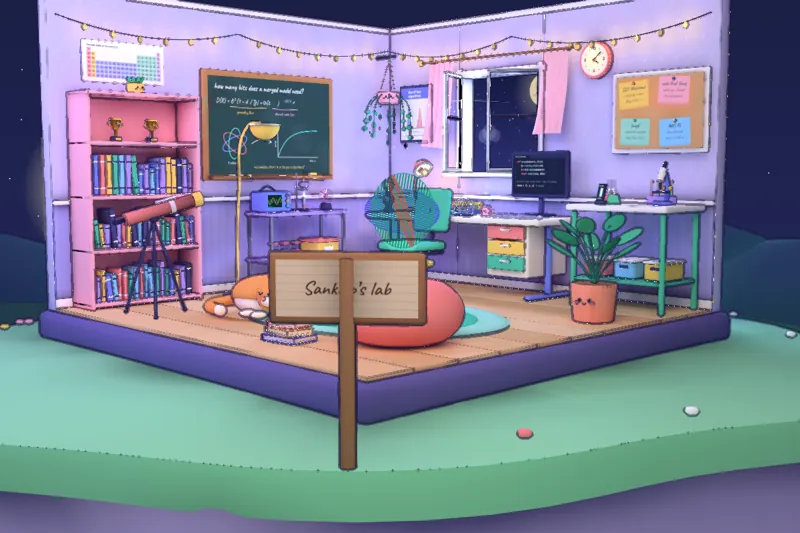
A softer finish
On top of the baked light, a finishing pass does the things that make it feel like a toy on a table: soft contact shadows where objects meet, thin pencil lines on the edges, a glow round anything bright, and a tilt-shift blur above and below whatever you're looking at.
It all runs in a few small render targets after the scene is drawn. The lines fade as you pull the camera back, so the whole map stays clean instead of turning into scribble.
A meadow you can build on
Outside the room is a meadow in the spirit of Tiny Glade. You draw and the pieces work out the rest: close a loop of wall and it becomes a building, and a path through a fence opens a gate. Run a path into a house and it gets a door; cross a stream or pond and you get a bridge.
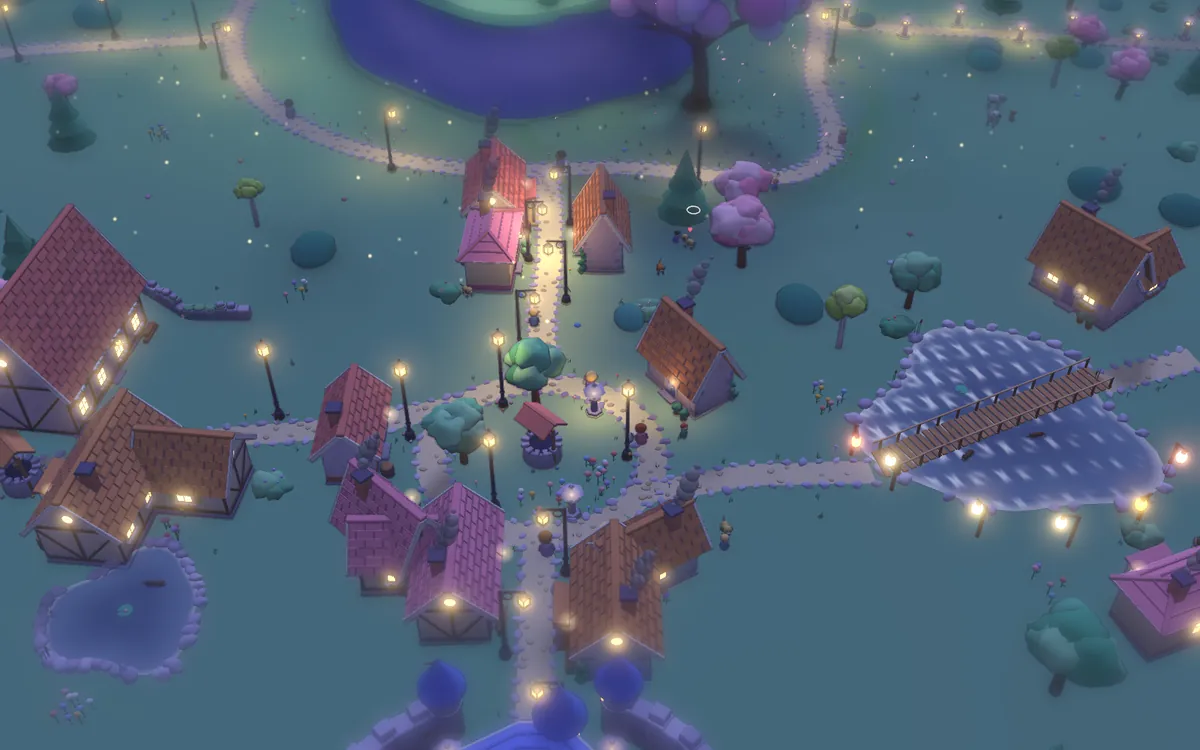
Unlike the room, built things get real light: the sun or moon with soft shadows, and after dark every street lamp and lantern lights the houses and the grass around it. Surprise me grows a whole village in one of seven layouts.
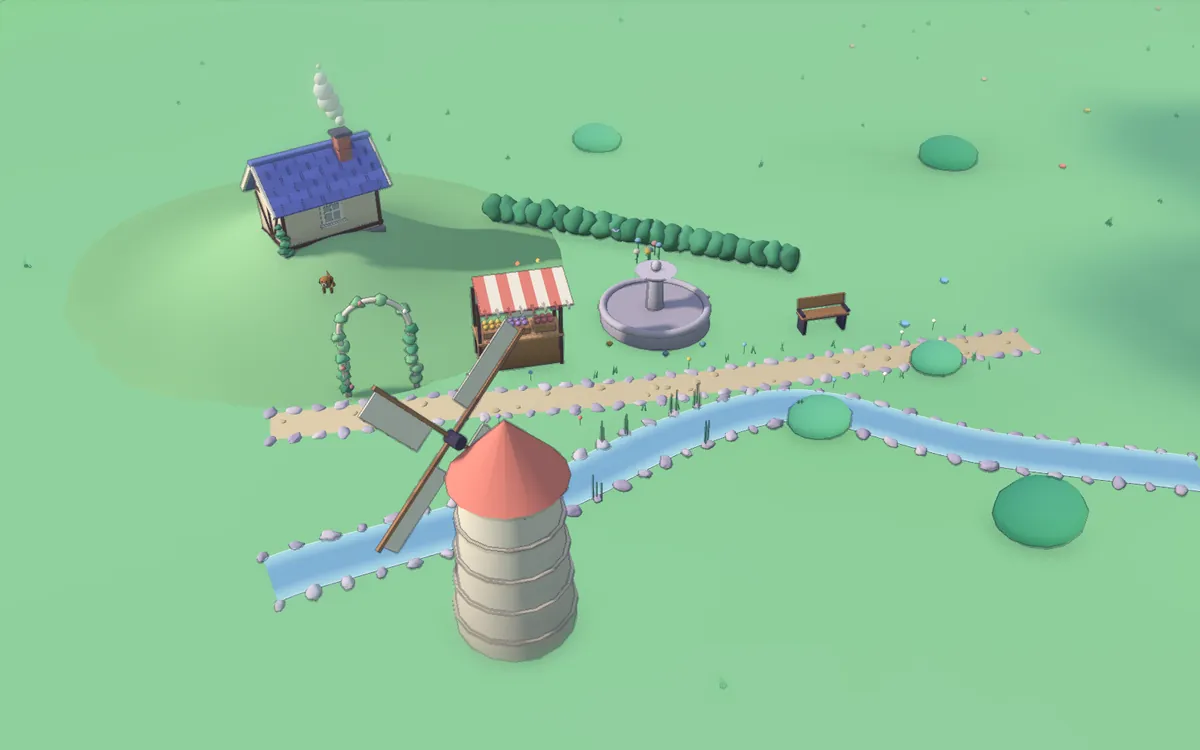
People, animals and a clock
Every house brings someone to live in it, and every other house brings a kid. They walk the paths and pet the dogs, and the kids chase the calves. At night they go home and the windows light up one by one. Otters swim in the ponds. Everyone has a name and a job, and clicking someone starts a little conversation.
Day and night come round every 20 minutes: ten minutes of day, a warm sunset, seven minutes of night and a sunrise. Birds cross the sky in the daytime and butterflies find the flowers in spring. Now and then someone wishes for something, a bench or a pond, and building it makes their day.
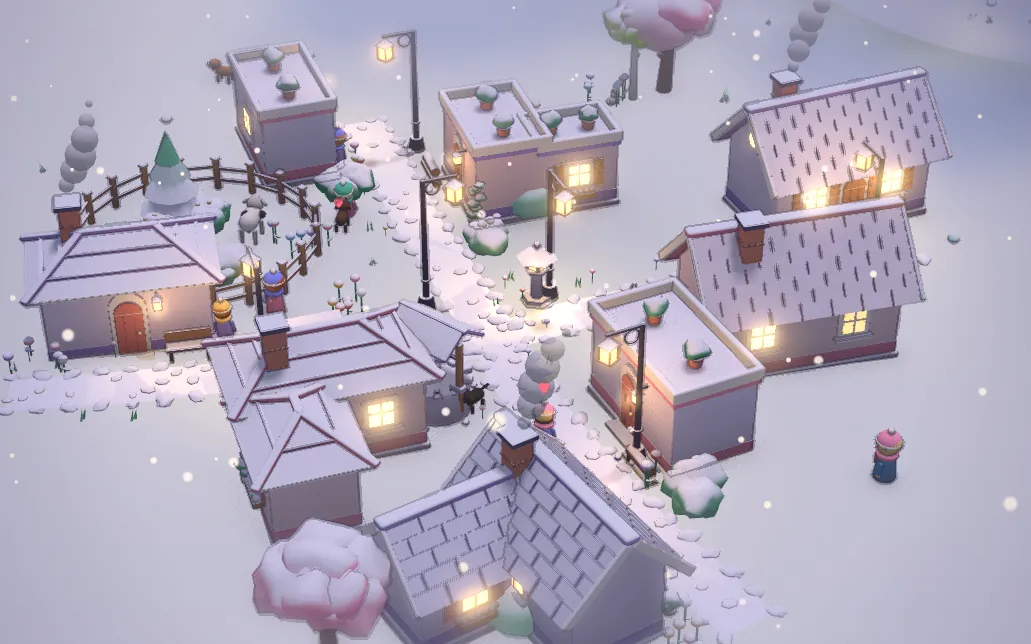
They have lives of their own, too. The baker keeps a smoking bread oven by the market stall, fishers fish, kids fly kites on the hills, and when it snows everyone builds snowmen. When night falls, the lamplighter walks round lighting the street lamps one by one, and the village gathers at the fountain. Villagers who chat on a bench become friends and visit each other, and you can ask them for things: the baker will bake you a loaf and bring it over.
You can also step in as a little person of your own and walk the village at their height. Paths lead you through gates, over bridges and through gaps in hedges, and walking into a front door takes you inside, where whoever lives there is pottering by the table. Footsteps change on paths, and the village murmurs louder where more people are.
Snow and rain
Snow and rain fall on the GPU inside a box that follows the camera, so there are thousands of flakes at almost no cost. The shaders read the season: snow settles on whatever faces up, ponds freeze, and snowmen appear by the cottages. When it rains, the ground darkens, puddles collect along the paths and umbrellas open.
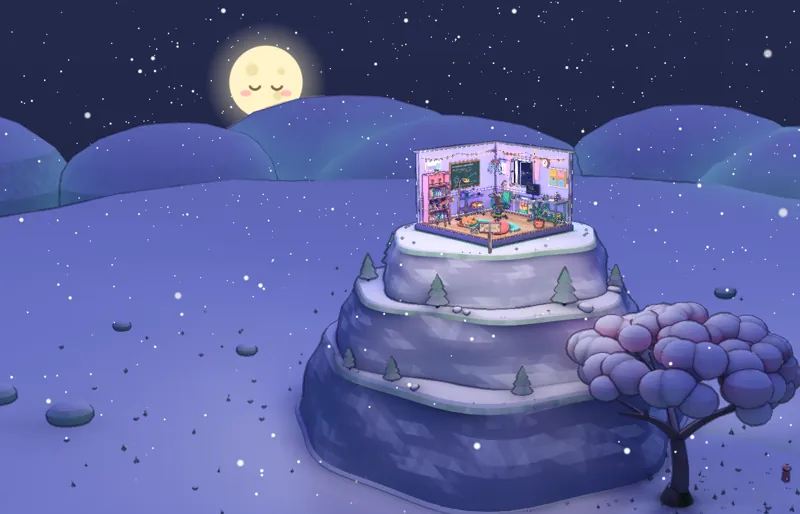
Photo mode
The Photo button hides everything but the scene. You can set the time of day and the season, then save a picture of your village with the sky behind it, a framed poster with its name, a 3D model to open in Blender, or a video of it growing piece by piece. Shared villages get their own short link whose preview shows the village.
It's all on the home page. Scroll to walk round the room, or build a village in the meadow and publish it for others to see.